Dhruv Meduri
Scientific Computing and Imaging Institute, University of Utah

I am a PhD researcher in Computer Science working on developing mathematical and algorithmic methods to understand and translate structure in complex, high-dimensional data into interpretable and actionable insights.
My work focuses on uncovering meaningful organization in data where standard approaches often fail to provide insight. A primary area of focus is understanding structure in learned representations in machine learning models—for example, I have studied graph neural network models for molecular data and shown that their embeddings capture chemically meaningful structure such as scaffolds and functional groups using topological methods, and developed interactive visualization tools to enable domain experts to explore and interpret these representations.
My research draws on tools from topology, geometry, and algorithms to develop principled approaches for analyzing complex systems and uncovering structure that is not directly observable through conventional techniques. I apply these ideas across diverse domains, including cheminformatics, neuroinformatics and dynamic simulation data.
I am interested in applying and extending these methods to challenging real-world problems, particularly in biological and biomedical domains where understanding the structure of data and models is critical for decision-making.
Publications
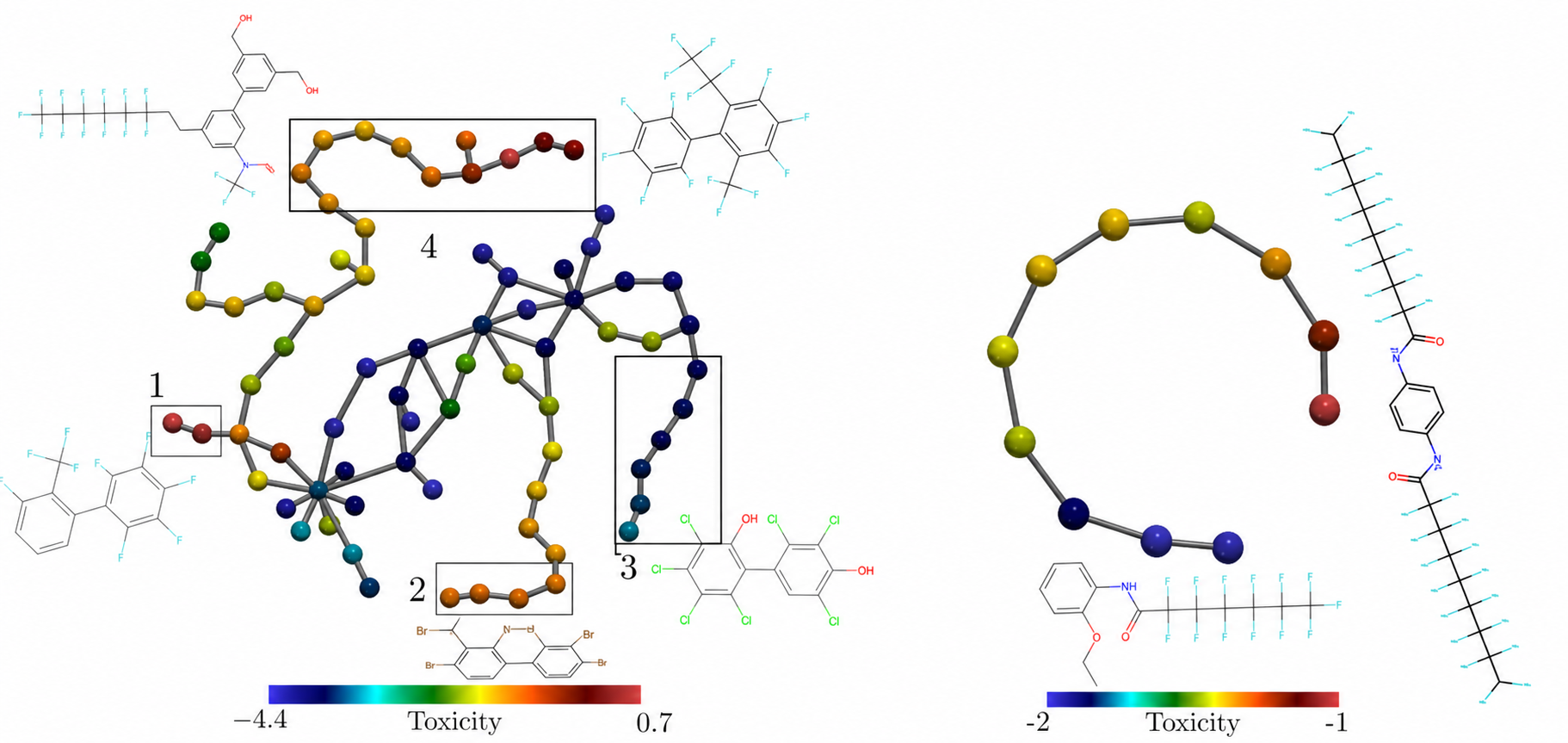
Mapping Chemical Space: Topological Data Analysis of Chemical Latent Space with Mapper
Dhruv Meduri, Chuan-Shen Hu, Cong Shen, Kelin Xia, and Bei Wang. In 42nd International Symposium on Computational Geometry (SoCG 2026), LIPIcs, vol. 367, pp. 78:1–78:20. Schloss Dagstuhl – Leibniz-Zentrum für Informatik, 2026.
Visual exploration of chemical latent spaces through topological data analysis and deep learning.
Chemical space contains an immense number of possible molecules and materials, making exhaustive exploration infeasible. This framework combines topological data analysis with deep learning, using Mapper to reveal the organization of molecular representations learned by geometric deep learning models. It exposes clusters, linkages, and branching structures associated with molecular scaffolds, functional groups, chemical properties, and structural and functional evolution.
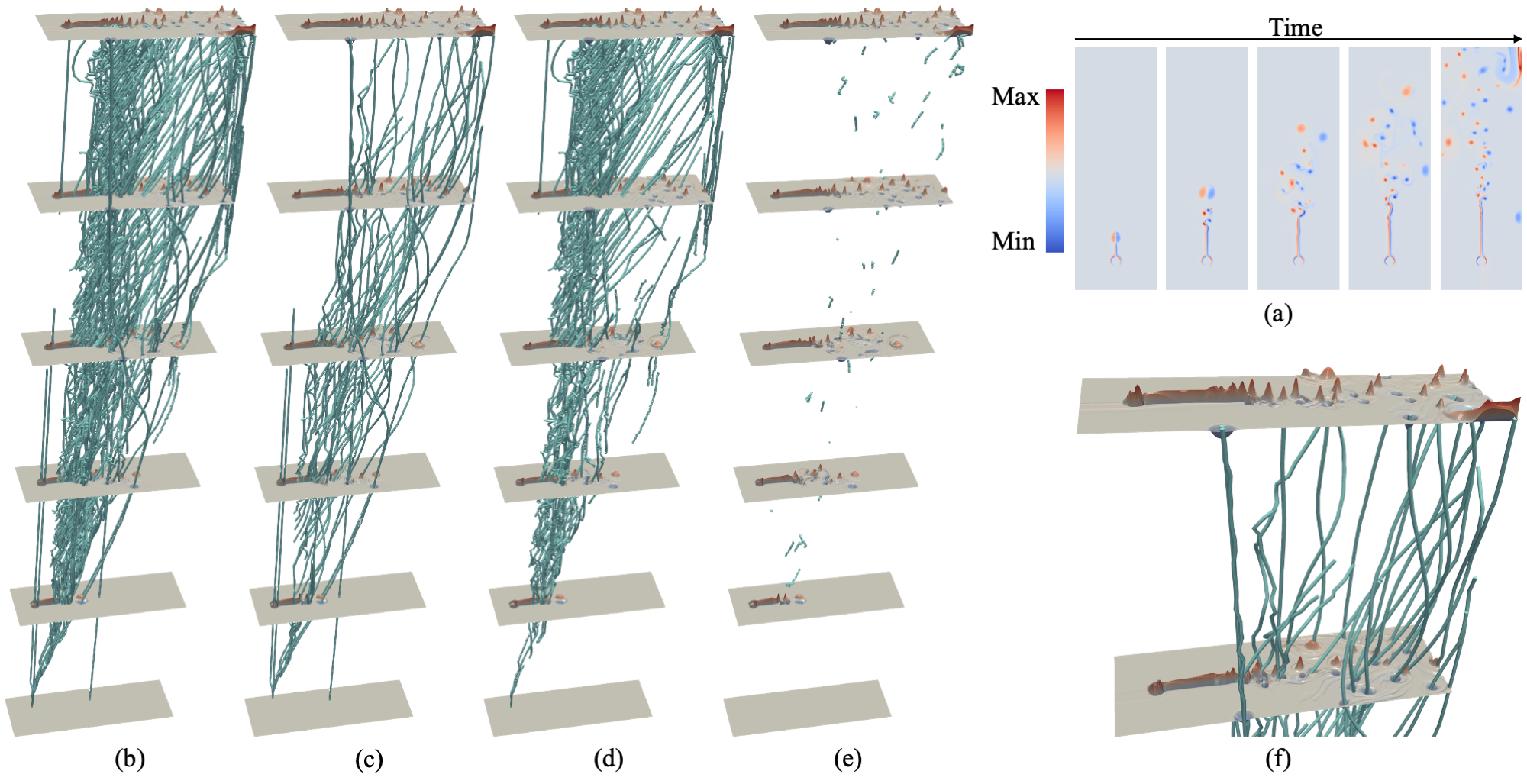
Jacobi Set Simplification for Tracking Topological Features in Time-Varying Scalar Fields
Dhruv Meduri, Mohit Sharma, and Vijay Natarajan. The Visual Computer, vol. 40, no. 7, pp. 4843–4855. Springer-Verlag, 2024.
Robust simplification of Jacobi sets for clearer and more reliable feature tracking in time-varying scalar fields.
Jacobi sets track where the gradients of two scalar fields align and, in time-varying data, trace the evolution of critical points. Because these sets are often complex and visually cluttered, this work introduces a robustness-based method for computing reduced Jacobi sets that retain structurally stable features. Mathematical analysis and experiments on synthetic and real-world datasets demonstrate clearer, more effective feature tracking.
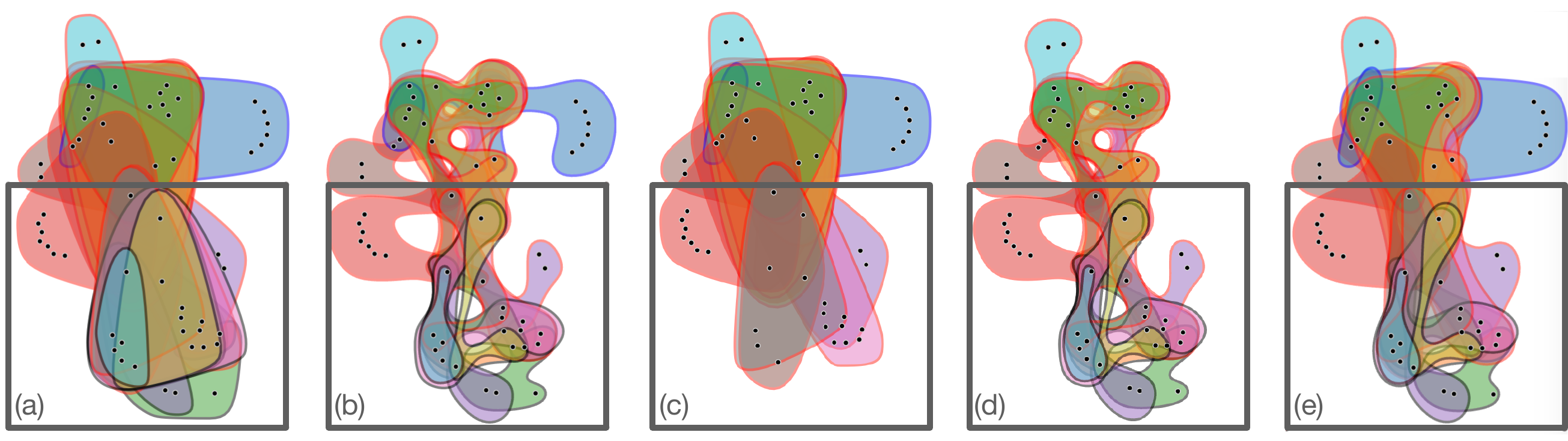
Sheaves for Visual Encodings and Visual Fusion
A sheaf-theoretic foundation for constructing and analyzing coherent visual encodings and visual fusion.
Visual encodings map data attributes to perceptual channels, while visual fusion combines multiple channels within a shared frame of reference. This work uses sheaf theory to formalize both as coherent local-to-global constructions. Four case studies—including composite scientific visualizations, glyph-based scatter plots, and edge blending for graphs and hypergraphs—motivate a set of axioms for a rigorous, unified theory of visual fusion.